DIGESTIV FELINE & GENERAL ANATOMY
As a carnivorous animal, cats have a digestive system that is much shorter in size compared to their body, with a ratio of 1:4. It has two functions, which are to digest and store food, but not in large amounts. The anatomy is designed only to digest nutrient-dense solid foods.
Cats have a very strict and unique dietary rule, in which their diet requires a very high and high-quality protein intake, which can only be found in animal-based foods.
In their digestive system, cats are not able to lower liver enzyme activity when given low-protein food, or in other words, cats need a sufficiently high protein ratio due to the high activity of liver enzymes that process protein into amino acids and then release it as energy.
Unlike omnivores (especially humans) that have Hexokinase and Glucokinase activities which function to convert carbohydrates into glucose and then the liver releases it as energy, in cats’ liver there is high Hexokinase activity but low or even no Glucokinase activity. That is why glucose/lactose content is not good (intolerant) and even toxic to their digestion.
Food is digested through the intestines and then absorbed to be distributed through the blood cells.
The pancreas and liver provide various enzymes whose function is to break down fat and protein into amino acids.
Cats, as animals with a short-type digestive system, certainly do not have the ability to digest plant-based sources, because cats have a very short and non-functional cecum and colon (large intestine) to digest fiber-based carbohydrates or to release nitrogen waste in large amounts.
This is supported by scientific facts that their colon (large intestine) has limited microbial fermentation activity and does not produce much Amylase enzyme, which is tolerant to carbohydrates or plant-based materials, especially during their growth period.
LOW GLUCOKINASE ACTIVITY
Diarrhea after drinking milk?
Basically, lactose is the main glucose component that makes up milk. Lactose intolerance is a condition in which an individual is unable to digest lactose — the sugar found in milk. This inability occurs because the cat’s digestive system does not produce enough lactase enzyme. Without lactase, lactose cannot be digested, leading to digestive disorders such as diarrhea.
Diarrhea experienced by cats due to lactose intolerance is not a permanent condition.
Post-milk diarrhea is NOT caused by the milk itself, but rather by a digestive system condition that sometimes is not compatible with the nutrients found in milk.
Food reaction or non-allergic intolerance can also occur not only because of lactose or certain types of fat, but also due to several ingredients in formula milk — such as pure milk protein (casein), gluten/plant-based ingredients, coloring agents, BHT used as a preservative to prevent rancidity, fat composition, corn oil, palm oil, creamer, and others.
Disturbances caused by formula milk incompatibility may appear as a fast reaction (within less than 8 hours) or as a delayed reaction (after more than 8 hours).
That is why we recommend consumers, before using Carnivora Milk products, to try a small amount first and wait for 8 hours.
THE ROLE OF COLLAGEN & GLUTATHIONE
Carrying the research concept of a “New Improved Formula” based on nutraceutical science, HexaMilk becomes a pioneer by introducing two superior ingredients that have never existed in its class before.
Collagen is an organic structural component of the body, responsible for building muscle mass, nails, skin and hair health, joints, teeth, and bone density. The fibrous nature of collagen provides strong resistance to pressure. It is one of the most essential proteins, especially for aging individuals. Collagen naturally enables the body to work more efficiently and produce its own collagen protein, without forcing it to absorb from synthetic sources. It plays an active role in recovery processes, maintaining skin and hair health, and preventing various issues such as fungal infections and hair loss.
Glutathione, also known as the “Master Antioxidant,” has been recognized by international medical experts as the most powerful antioxidant, as many bodily cell functions depend on it.
Some of the benefits and functions of L-Glutathione include:
- Repairing and rapidly strengthening the immune system.
- Increasing antibody production.
- Acting as an antioxidant and anti–free radical agent.
- Regenerating oxidized vitamins C and E — thus playing a vital role in reactivating these vitamins from nutritional intake.
- Performing detoxification (removing toxins or carcinogenic substances, especially in adults). There are at least 12 types of carcinogens that can be detoxified (neutralized) by Glutathione.
100% REAL WHEY
Whey protein is now recognized as the best source of protein compared to other protein sources due to its complete amino acid profile. Another equally important aspect is that whey protein has a higher Biological Value (BV) than other protein sources, meaning it can be absorbed and utilized by the body more efficiently.
HexaMilk Whey Protein is produced using ultrafiltration technology to isolate the pure protein core from liquid whey found in fresh milk. We are affiliated with one of Europe’s best dairy producers, Evolene Switzerland.
The ultrafiltration process works by separating the whey protein core from lactose and other components by pushing the liquid whey through an extremely fine membrane — with pore sizes between 0.05 nm and 1 nm, even smaller than bacteria. The liquid protein is retained by the membrane, and since this separation process does not require any additional chemicals, it preserves the purity and sterility of the final product.
NEW & IMPROVED FORMULA
HexaMilk is a nutraceutical-based nutritional supplement formulated and manufactured under GMP standards to ensure the highest quality and product integrity. Developed through continuous research and development with the theme “New Improved Formula,” HexaMilk is designed to deliver a more refined and professional-grade product.
HexaMilk serves as an alternative nutrition source for kittens who do not receive enough mother’s milk, experience decreased appetite due to illness, suffer from malnutrition, are in recovery, or for pregnant and lactating queens needing additional nutrition.
It contains 40–45% protein with a Biological Value (BV) of around 100–104, providing a rich amino acid profile that is easily absorbed and utilized by the body. The protein particles are extremely fine, making digestion more efficient — unlike casein-based milk proteins, which are often harder to digest, especially for newborns and kittens.
Note: Mother’s milk and a balanced nutritional diet remain the best choice.
RECOGNIZE THE SYMPTOMS OF DIARRHEA & MILK ALLERGY IN CATS!
Basically, lactose is the main glucose component that makes up milk.
Did you know?
Rejection of milk by the digestive system can occur for two reasons:
First, due to lactose intolerance, and second, due to a milk allergy.
Although both conditions may show similar symptoms, they are actually different.
Diarrhea experienced by cats with lactose intolerance is generally not a permanent condition.
Post-milk diarrhea is NOT caused by the milk itself, but rather by the digestive system’s incompatibility with certain nutrients in the milk—aside from lactose intolerance, which is a manageable and preventable condition.
Milk allergy, on the other hand, is a hypersensitivity reaction to milk proteins involving the immune system. It occurs when the cat’s immune system mistakenly identifies milk protein as harmful and reacts abnormally to it. The cat’s body then attacks the milk proteins, causing various allergic symptoms.
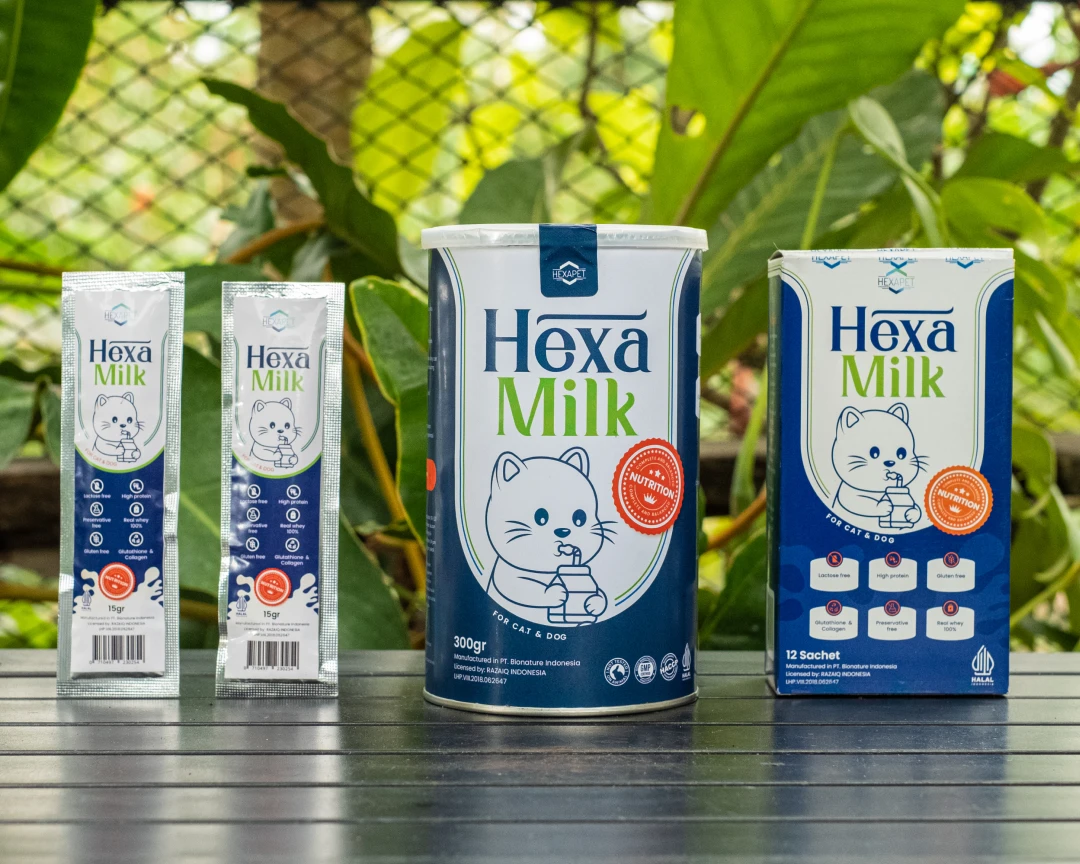
HexaMilk Substitute Milk is specially designed to be not only low in lactose but completely lactose-free and gluten-free (plant-based ingredients) — formulated to minimize the risk of both lactose intolerance and milk allergy.
COMPLETE & BALANCED NUTRITION
- Lactose-Free
- High in Protein
- Grain-Free (No Plant-Based Ingredients)
- Made from 100% Whey
- Preservative-Free
- Contains Glutathione & Collagen
MILK FEEDING GUIDELINES
In general, the ratio for both kittens and adults is 1:2 between milk and water.
For kittens (1st age), prepare 15 g (1 tablespoon) of milk with 30 ml of warm water (preferably warm for kittens).
This portion suits an individual weighing 110–120 g and can be divided into 8 feedings within 24 hours, or roughly every 3 hours.
| Age | Feedings/Day | Milk Volume (ml) |
|---|---|---|
| Newborn | 7–8x | 3–4 ml |
| 2 weeks | 6x | 5–10 ml |
| 3–4 weeks | 5x | 10–15 ml |
- For cats weighing 2 kg as maintenance or daily supplement, give 7 g once daily.
- For individuals 2 kg and above that are sick, malnourished, lactating, or pregnant, give 10 g twice daily.
- Prepared milk should only last 1 hour at room temperature or up to 24 hours in the refrigerator.
- Opened powder packaging should be used within 10 days, with a total shelf life of 2 years.
Product Composition
- Collagen and Glutathione
- Free from Casein
- 100% Whey Milk Concentrate
- No Gluten
- 100% Free from Lactose and Synthetic Sweeteners
- Protein Value: 40–45%
Note:
In adult cats, soft stool may occur — this is considered normal. It happens due to the digestive detox function in the milk, which helps cleanse old residue accumulated on intestinal villi caused by prolonged consumption of plant-based dry food. This is a temporary condition and not harmful.
Warning:
If kittens experience diarrhea or lethargy, consult a veterinarian immediately.
Mother’s milk and a balanced nutritional diet are always the best.
Feeding Frequency (Within 24 Hours):
- 4-week-old kittens: Every 6 hours
- 3-week-old kittens: Every 6 hours
- 2-week-old kittens: Every 4 hours
- 1-week-old kittens: Every 3 hours